Showing posts with label Swearengen. Show all posts

Thursday, June 13, 2019

Mr. Swearengen Goes to Washington


My previous posts regarding newspaper accounts of Deadwood in the 1870s are available at these links.


#I  Introduction. Deadwood, the Series and Contemporary News Accounts.
#II Sheriff Seth Bullock in Old Deadwood Newspapers.
#III Seth Bullock on the Trail of Stagecoach Robbers.
#IV 1876 in Deadwood.
#V Seth Bullock and the Stolen Election. 
#VI Some correspondences and dispatches from early Deadwood.

#VII Ten Surprises I Encountered When Researching Deadwood.  

#VIII Starting a Graveyard in the Black Hills

Today's entry looks at the transition days for the Black Hills gold find. Originally, the government pushed the line: this is Indian territory and we must follow the treaty. Prospectors were rounded up and told to go home. Soon it became: hands off, the miners can come. Finally, it became: the treaty is abandoned, the remaining Native Americans must leave.

Swearengen was sent as a representative to Washington, D.C. to lobby to help this transition take place.

Bismarck weekly tribune, January 12, 1876, p. 5.

THE BLACK HILLS OPEN.
The Black Hills are practically open. Men go and come without molestation or interference from the military or Indians. Indeed it is understood that commanding officers have been directed to suspend all action in relation to miners until further orders, while all but the hostile Indians, who have no rights anyway, are ready to sell, and the Hills are filling up with miners who expect to stay.

Claims are a city being developed; a city is being built up, and improvements of a permanent nature are being made; and it is well for those who think of going to get themselves ready business with the opening of spring.

Mr. Swearengen who was sent by the miners, at the Custer City meeting, as a delegate to Washington in the interest of the opening of the Hills, has returned to his post, confident that things are working, and that the Hills will soon be proclaimed open to all, as they are now open to those who do not hesitate to defy ordinary dangers.

Elsewhere will be found an interview with Gen. Custer, had by the writer immediately after the return of Custer's Black Hills Expition [sic] in 1874.

He speaks of tho necessity of opening the Hills, looking at the question from a military stand point, and sees the difficulties to be met in keeping back the hardy minters; he details the character of the miners, and shows that dirt yielding two dollars to the pan was examined by him; he refers to a richer region than the French Creek mines, (Custer Park or Gulch) not examined by his miners, being the Rapid Creek mines of which Jenney speaks so favorably. He mentioned, also, the Belle Fourche mines, which are claimed by the miners to be still richer. These are still nearer Bismarck. Finally he speaks of a route to the Black Hills, leading in a southwesterly course from Bismarck.

This route has since been travelled by Capt. Fisher and others, and has been proven to possess all of the advantages claimed for it by Gen. Custer. He speaks of the agricultural wealth of the Hills,
and insists that nature could not have done more for any region.

But enough on this point. The General speaks for himself, elsewhere.

Mr. Swearengen, speaking of the Black Hills to a Sioux City reporter, says he was in the mining business on the Pacific coast for 30 years, and he believes—forming conclusions from actual observation—that the Black Hills region affords the richest mineral fields extant. The Black Hills afford a good country for the poor man, for they abound in placer diggings, which can be worked with little means, while quartz mining requires large capital but there are extensive and valuable quartz leads in the Hills, which capital will develop sooner or later. He speaks, also, of the rich agricultural resources of the Hills, confirming all that has been said by
Custer and others.

But on they points there has long since ceased to be doubts. The only question now is, will the Government permit the occupation of the Hills? We reply, they are permitting such occupation, and advise those who want to go to come on, for the Black Hills are now practicaly [sic] open.


Jack McCall, Hickok's assassin


Kelly Company, makers of metal detectors and all things for modern prospecting, have written an article regarding the Black Hills Gold Rush. 
Wednesday, June 12, 2019

Starting a Graveyard in the Black Hills


Previous entries in my series regarding accounts of Deadwood in newspapers.

#I  Introduction. Deadwood, the Series and Contemporary News Accounts.
#II Sheriff Seth Bullock in Old Deadwood Newspapers.
#III Seth Bullock on the Trail of Stagecoach Robbers.
#IV 1876 in Deadwood.
#V Seth Bullock and the Stolen Election. 
#VI Some correspondences and dispatches from early Deadwood.

#VII Ten Surprises I Encountered When Researching Deadwood. 

The story presented below first appeared in a St. Louis paper and was reprinted in newspapers across the nation. It came out about two months before the Black Hills Pioneer began printing. I encountered it while searching for Swearengen articles, although this story only mentions him in passing.

STARTING A GRAVEYARD.

The First Inquest and Funeral in the Black Hills -- A Traveler's Story of Burial in the Wilderness.

Death demanded a sacrifice. A graveyard had to be started in Custer City. No one had volunteered to die and no ruffian had offered a sacrifice. Fate led Charley Holt and John Picket across the plains from Sioux City, and hope and ambition led them to "drive their stake" upon the southern slope in the suburbs of Custer. Poor boys! they were not yet men and their combined fortune and early effects would not reach $5 in value. They selected a town lot upon a grassy knoll, close to a small grove of straight, tall pines, and being unable to chop large logs or buy lumber with which to construct a habitation, dug a cave. These boys made their deadfall eight feet squared, covered it up with pine brush, propped this up with eight small poles, threw on several tons of earth, and went to bed to dream of home, of mother, of father and of the fortune they, in their boyish imaginations, had already carved out of these golden realms.

When morning came a sad sight was revealed to the young man who went to the dugout to borrow a shovel. The angel of death had been there in the night and buried the sleeping boys alive. A faint piteous beneath this living grave broke the icy stillness of the frosty morning, crying out: "In God's name, pull me out! I am dying." The boy who had come to borrow a shovel from the fatal spot, calling loudly for help, which came from all directions, from fifty cabins in the gulch. A dozen yeoman arms delved down and tore away the cruel earth which had already clasped and claimed one of these boys as its own, and which had hugged and pressed in its icy embrace, for eight long hours, the struggling survivor. The story told by the mangled and mutilated youth is a brief one. He told it to me while gasping in agony and pain, stretched upon a couch of pine boughs on the hill side.

"We finished out 'dug-out,' and I went down town to beg for work or flour. We had eaten up our last grub. Charlie --- that's my pardner --- stayed at home to fix up things and finish digging out the chimney. I went to the miners' meeting at the Swearenger's saloon, and came home about ten o'clock, and went to bed. When I woke up I was buried, but I had one had one hand free, with which I scratched away the dirt and brush and got air. Then all was dark again, and awhile, I woke up. I could see the stars and the moon, and I heard Charlie calling for me to help him. I tried to move, but the dirt came tumbling in on my face, so I quit. Then Charlie said: 'Johnny, I am dying; write to my mother.' I called out: 'Charlie, I can't get out; God help you; we must die!' then all got dark again. That's all I know, sir, till just now. Is Charlie dead?"

Yes, Charlie was dead! His crushed and mangled body was dragged out of the debris a few minutes afterward, and borne down the hillside to a deserted soldier's cabin, and laid out upon a plank place upon two logs.

Then came the inquest --- first held in the Black Hills. It was a queer scene. There stood the city marshal, a tall, rough, honest man, with bronzed-brown face and tear stained eyes, a pair of navies on his hips, but gentle as a lam in the face of a death like this.

The coroner, a miner with grizzled beard and hard, grimy hands, stood by the body with a book in his hand. Two doctors, just arrived that morning from Platte county, Mo., looking more like tramps than professional stood by. A reporter, a clothing dealer, a saloon keeper, a lawyer and two miners constituted the jury, which sat itself upon a log which insisted upon rolling over every two minutes. The inquest was brief, the reporter organized the jury, swore them in, elicited the evidence, made the verdict, and founded the first official archive for the city. The verdict was "accidental death from suffocation;" that was all, and material was ready to start a graveyard in Custer.

Then came the humane hands and kind hears and dressed the unfortunate stranger. One of the miners found a white shirt, the only one it the city, a sheet was converted into a shroud, and Charley Holt soon lay in a rough pine box upon a bier of logs. This was not all, a fire was built in the corner of that black, deserted cabin, the roof opened to allow the smoke to escape, and then a half dozen noble men sat and watched until daylight. They were bound to start a graveyard. With the rising of the sun came ladies --- yes, ladies; kind hearted pioneers who had woven a wreath of pine twigs, winter ivy, pine cones and four little fragments of white tarlatan and pieces of the black silk strings of a bonnet. This wreath was laid reverentially upon the unpainted pine box; it was all these five noble hearted women could do, and they did it well. But still the graveyard was not inaugurated. Here was a corpse neatly shrouded, wreathed and coffined, and no graveyard; but a site for a city graveyard was found --- a natural cemetery already planted with groves of trees, and laid out by nature into broad, irregular avenues, all sodded and half green. Cascades, ornamented with glittering icicles, lent their aid to the frosted evergreen foliage and snow white grotto of quartz to beautify the newly selected site for the city of the dead.

A half dozen brawny athletes, with pick and shovel, tore open the virgin soil, and made the grave. They were generous sextons, these amateurs, and sunk a hole like unto a mining shaft. It was at least twelve feet long --- this grave for the half-grown boy. But the trouble was only half over. There is no preacher in Custer, and a two hours' canvass of the city failed to find a professor of religion among three hundred people. Worse than that, a close search failed to find a prayer book. The mayor, honest man, appealed to one of the two lawyers in the city to "say a few words at the grave, to be Christian-like," but such pleading was not in his line; so the three doctors were appealed to, but with like success. Then came a committee of judge, mayor and marshal to the reporter. Surely a "paper man" knew something about funerals; and, said the mayor, "we want to put the poor lad away a king o' Christian like; not like a dog." Besides, a graveyard had to be started.

Then came Miss Ida Simms, like an angel of goodness, with a small gilt-edged Bible, the only one in the city, and the funeral cortege moved on through the main street of the city. It was a picturesque scene on this bright, sunny day. A wagon containing the unpainted coffin, upon which lay the ladies' evergreen wreath. Then the mayor, judge, councilmen, and marsh, rough, blue-shirted men in miners' boots and slouch hats. A dozen or two miners, merchants ad hunters brought up the rear, and the procession moved silently on.

Then a shallow grave on the hillside, sunk, as one of the amateur sextons said, "clar down to the bedrock, gentlemen, down what the dirt shows good color." Silently the body was taken from the wagon and tenderly laid in the golden earth upon the bedrock. Then every head was bared and every bronzed countenance bowed while on or two selections of Scriptures were read. The grave was soon filled and a white pine headstone set in the earth, and thus the city of Custer inaugurated its graveyard.

The saddest point about this affecting incident is yet to be mentioned. No letters, papers, or even the slightest clew to his home or friends have been found. All that is know is that walked all the way to the Black Hills to die and start a graveyard.

As reprinted in the Connecticut Western News, April 21, 1876, p. 2.

The Bismarck Weekly Tribune had this brief note about the new cemetery.

Custer City has started a grave-yard. A man killed his partner, and was fined for shooting in the city limits.

Bismarck weekly tribune, April 12, 1876, p. 3


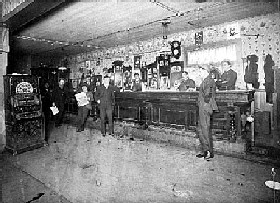
Inside the Gem Saloon