Showing posts with label Arthur Conan Doyle. Show all posts

Wednesday, November 9, 2016

The Complete Sherlock Holmes: A Review of the #1 Entry on the Mystery Writers of America List

I am reviewing the top 50 mystery novels which appeared on the Crime Writers' Association and the Mystery Writers of America best mystery lists. I began with the the first choice of the CWA, The Daughter of Time.  I am continuing by switching over to the first entry on the MWA list, The Complete Sherlock Holmes.

Author: Arthur Conan Doyle
Entry: The Complete Sherlock Holmes, 4 novels and 56 short stories.
Publication: 1887 to 1927


#1 on the MWA list, included as #21 on the CWA list as The Collected Sherlock Holmes Short Stories, and #32 as The Hound of the Baskervilles.
Word Count: ~660,000
Age of author at time of publication: 28 to 68.
Previous novels published by this author: none.
First words: In the year 1878 I took my degree of Doctor of Medicine of the University of London, and proceeded to Netley to go through the course prescribed for surgeons in the army.
Last words: . . . the lucky owner got away scatheless from this strange incident in a career which has now outlived its shadows and promises to end in an honoured old age.
Significance: By far the greatest influence on the detective story. The most enduring literary character, period. Ripping good yarns.
 

Where to start in a critique of Sherlock Holmes adventures? I guess I should declare that I am, in a minor way, a Conan Doyle scholar. Along with researching Conan Doyle to include him in my mystery, A Predator's Game, I have an article forthcoming in the prestigious Baker Street Journal, a 70-year-old publication dedicated to all things Sherlockian.

Now as it has for 120 years, Sherlock Holmes has continued to demonstrate a remarkable popularity:
  • BBC's current series is a geekfest for a new generation. 
  • Robert Downey, Jr., the highest paid actor of 2015, recently starred in two comic bookish free adaptations.
  • Sherlock Holmes was cited in Guinness Book of World Records as the fictional human character most frequently adapted to film and television (Dracula, non-human, is in the lead). The survey notably left out Dr. Watson who appears in nearly all of the Sherlockian adaptations.

Dr. Gregory House, a literary descendant of Holmes. The "homage" of his home address is a bit too spot-on.

One of the joys of Sherlock Holmes comes from Conan Doyle's attention to world-building. The stories are set in a matter-of-fact existing world, a world that feels lived in even when the players are not out having adventures. One way in which this is done is by Conan Doyle often referring to stories that had never been written. Why did Sherlock Holmes seem so brilliant and his cases so exotic? Watson puts forward that there were many more adventures that were either mundane or else failures on the part of Holmes. He chose the good ones. And I nod and think, that makes sense.

The first forty-six short stories and all of the novels of Sherlock Holmes are public domain. The final ten short stories are not. If you are interested in saving money, there are many inexpensive editions that include the public domain works before having to go on to the final story collection: The Case Book of Sherlock Holmes.

(Note to the Doyle heirs. To extend your publication rights: The Cookbook of Sherlock Holmes.)

The endings in several stories were morally ambiguous. Irene Adler bests Sherlock Holmes. Moriarty kills him (although not permanently).

The final stories end on a gloomy note. The Adventure of the Retired Colourman, the last entry in The Case Book, features a killer who gases his victims in a sealed room later taking on Sherlock Holmes's detection as sport.

In that story Sherlock Holmes declares: But is not all life pathetic and futile? Is not his story a microcosm of the whole? We reach. We grasp. And what is left in our hands at the end? A shadow. Or worse than a shadow - misery.

Personal Verdict: Sherlock Holmes is by far the single most important formative influence in the history of detective fiction. Great reads of a world frozen in time.

Quibbles: Conan Doyle too often lapses into stereotypes and prejudice of his day. His villains include East Indian cults, voodoo practitioners, and evil Mormons. His portrayal of the last of these groups stains A Study in Scarlet, the novel with Holmes's debut.
Brendan Cumberbatch is an excellent actor and the embodiment of the modern Holmes but the BBC series writer Stephen Moffat is joyously, brilliantly clever to which he adds on too clever by half.

Other related posts:
The Crime of the Century
Nikola Tesla versus Sherlock Holmes.
Arthur Conan Doyle Versus the Evil Holmes

-------------------

Martin Hill Ortiz is the author of Never Kill A Friend, Ransom Note Press.


Never Kill A Friend, Ransom Note Press

Never Kill A Friend is available for purchase in hard cover format and as an ebook.
The story follows Shelley Krieg, an African-American detective for the Washington DC Metro PD as she tries to undo a wrong which sent an innocent teenager to prison.

Hard cover: Amazon US
Kindle: Amazon US
Hard cover: Amazon UK
Kindle: Amazon UK
Barnes and Noble 


Tuesday, April 12, 2016

The Crime of the Century

THE CRIME of the century occurs every few years, once the fervor generated by the previous candidate has dissipated enough to permit the media to dust off and reuse the phrase.

During the decade of the 1890s several murder cases captured the public's imagination to compete for the title of the crime of the century. Many of the most notorious are relatively forgotten, including Eleanor Pearcy, Amelia Dyer and Joseph Vacher.

Some are still well-remembered: the killing of the parents of Lizzie Borden; the murderous career of Dr. Thomas Neill Cream and the infamy of Dr. Henry H. Holmes.

One newspaper article which catalogued these names, now seems cryptic. ". . . [Since Lizzie Borden,] remarkable murder trials in the United States have been multiplying at a rapid rate. New York contributed two celebrated cases--Carlyle W. Harris and Dr. Buchanan, both within two years. Then came the Durrant case in San Francisco, and the Holmes case here. The trial of the actor Gentry for the murder of Madge York will also prove notable in criminal annals." [Philadelphia Inquirer, November 3, 1895, p. 6]


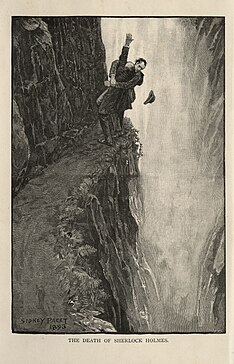
One crime, however, had the whole world talking about it. As was first reported in the December, 1893 edition of The Strand Magazine, Dr. Moriarty and by extension, the author Arthur Conan Doyle, had killed Sherlock Holmes.

Never had such a cruel or more wanton act of literary savagery ever been conceived of and enacted upon. While within novels, heroes died noble, tragic deaths, authors did not kill off their popular creations that had survived so many dangers, for Holmes, at that time, twenty-six adventures.

Having debuted a mere six years back, Sherlock Holmes was internationally famous and well-loved. Chiefly as a result of Sherlock's success, Arthur Conan Doyle popularity had reached that of Kipling, Stevenson, and Hardy. Considering the pay given to the author, it seemed to be an act of financial suicide.

Holmes's death inspired obituaries.

DEATH OF SHERLOCK HOLMES.

Sherlock Holmes is no more. He dies with his name ringing in men's ears. The police of the world are left with their inferior resources to deal with crime as of old. [South Wales Daily News, December 14, 1893]


As for the murderer? Dr. Arthur Conan Doyle claimed justifiable homicide.

"I have come to take you in custody for the killing of Sherlock Holmes," I [the reporter] said, as soon as we were seated.

 "Ah, but I did it in self defense," he [Conan Doyle] replied. "And if you knew the provocation you would agree with me that it was justifiable homicide. When I invented this character I had no idea he would give me so much trouble. But when Holmes' Adventures began to appear in the Strand Magazine, its circulation went up by leaps and bounds until it reached the phenomenal figure of 400,000. No sooner had one story appeared than I was set upon for another, and such considerable sums of money were offered by the publisher, indicating a popular demand so imperative and so flattering, that I was tempted repeatedly from other work which I greatly desired to finish. I went on from one case to another until, as you know, there are now two volumes of "The Memoirs and Adventures of Sherlock Holmes." At last I killed him, and I had not done so I almost think he would have killed me." [The Press, New York. June 10, 1894, Part IV, p. 1]

The press accused him of murder by melodrama.

"Is it the artistic termination to a career like that of Sherlock Holmes . . . he should topple into "a boiling pit of incalculable depth" formed by raging waters beneath? I think not. [A Great Detective. The Leeds Times, December 16, 1893, p. 4]

"The truth is that Dr. Doyle's ingenuity, so brilliantly exemplified in many a story of adventure, has proved unequal to the final catastrophe of his hero." [Exit Sherlock Holmes, Guernsey Star, December 21, 1893, p. 1]

The killer showed some remorse:

"Yes, it is a case of cold-blooded murder," said Dr. A. Conan Doyle, in conversation with a Post reporter at the Burnet House, "and when I killed Sherlock Holmes I killed my best friend." [Pen Picture, The Cincinnati Post, October 17, 1894, p. 2]

The Ghost.

The career of Sherlock Holmes did not need to wait for his resurrection in order to continue. A popular song of the day had the ghost of Holmes solving crimes.

Sinners shake and tremble
Wherever this bogie roams,
And people shout, 'He's found us out,
It's the ghost of Sherlock Holmes'

The man who plots a murder, when
He sees me flit ahead,
Forgets to murder anyone,
And 'suicides' instead.
An anarchist with lighted bomb
To cause explosive scenes,
Sees me and drops the bomb, and blows
Himself to smithereens!

From: The Ghost of Sherlock Holmes, Richard Morton (lyricist of Tra-la-la Boom-de-Ay).


Sherlock Holmes and Professor Moriarty at the Reichenbach Falls.jpg
Sherlock Holmes fighting Moriarty at the brink of Reichenbach Falls. Sidney Paget, illustrator.


Nikola Tesla, Arthur Conan Doyle and Dr. Henry H. Holmes are all characters in my thriller, A Predator's Game.

A Predator's Game is available in soft-cover and ebook through Amazon and other online retailers.


A Predator's Game, now available, Rook's Page Publishing.

 -----------------------

Back page blurb.

Manhattan, 1896.

When the author Arthur Conan Doyle meets Nikola Tesla he finds a tall, thin genius with a photographic memory and a keen eye, and recognizes in the eccentric inventor the embodiment of his creation, Sherlock. Together, they team up to take on an "evil Holmes." Multi-murderer Dr. Henry H. Holmes has escaped execution and is unleashing a reign of terror upon the metropolis. Set in the late nineteenth century in a world of modern marvels, danger and invention, Conan Doyle and Tesla engage the madman in a deadly game of wits.

Martin Hill Ortiz, also writing under the name, Martin Hill, is the author of A Predatory Mind. Its sequel, set in 1890s Manhattan and titled A Predator's Game, features Nikola Tesla as detective.


Tuesday, March 22, 2016

First Chapter of A Predator's Game.

A Predator's Game 
Martin Hill Ortiz
2016, Rook's Page Publishing 

A Predator's Game is available in soft-cover and ebook editions through Amazon and other online retailers.


The First Chapter


       The man in the bowler hat stepped off the horse-drawn trolley. Overdressed for the sultriness of June, he wore a dark gabardine topcoat, its perfect tailoring drawn snugly over the muscular block of his shoulders. His shoes beamed from a recent shining, and his polished cufflinks winked in the midday sun. He clasped the whalebone grip of his walking cane, his thick-knuckled fingers clenching and unclenching in a strangling motion. Tipping his head back, he gazed skywards, beyond the valley of buildings, drinking in the sun until his eyes teared over. He then dipped his head down and surveyed the Eden Musée.
            Built with continental pretensions, the three-story dime museum presented a French Gothic façade with statues of plump ladies serving as columns. A decorative arch displayed a carving of sea nymphs. Its steep roof sloped over its third floor, plunging down to meet an ornamental railing. Garish streamers hung slung from window to window. A banner screamed in three-foot-tall letters: Open To All! Come Visit Our Chamber of Horrors!
Eden Musee
The Eden Musée at its most garish.

            The pompous building summed up everything Dr. Henry Holmes loved and loathed about Manhattan: hypocrisy inflated to a grand scale, with the high-minded fused to the tawdry. While crossing the street in front of Lord & Taylor's, society dames wearing feathered headdresses took dainty hops over lumps of horse manure. On Park Row and by City Hall, men in top hats bemoaned the plight of the poor while wringing every cent of change from the ragged newsies. Sulfurous clouds of coal dust drifted down from the belching steam engines of the elevated-above-it-all trains. Progress as the religion of heathens. Culture, yes, but as fake as a blush on a prostitute's cheeks.
            The doctor strolled into the lobby of the self-proclaimed “People's Museum.” The wax sculpture of a portly policeman flanked the ticket seller's booth, its glass eyes glistening. "Woe to ye pocket-pickers!" its placard read. "Our bluecoat is ever the vigilant." Holmes handed over a dime.
            A gypsy woman sat at the threshold of the entry hall, behind a narrow oak table. She wore a tent-like dress spacious enough to hide a nest of children. Her face was moon-round with large expressive eyes accentuated by bangles of sleeplessness. Her eyelids sparkled with blue glitter; her fake lashes flapped like the wings of a luna moth. Pancake make-up deadened the shine on her face. A parrot rested atop her suede shoulder patch, one of its legs was tethered by a lace to her wrist.

5¢. THE MYSTERIES OF THE FUTURE REVEALED. 5¢.
ALL FORTUNES GUARANTEED
MADAME GRENADINE KNOWS ALL!

            Access to a font of infinite knowledge proved impossible for Holmes to resist. He spun a five-cent piece on the tabletop.
liberty nickel
The Liberty Nickel

            The parrot hopped from the gypsy's shoulder, landing on the rim of a glass bowl where it bobbed its head down, plucking up two strips of folded paper. After shaking one loose, it dropped the other in front of the customer.
            Holmes unfolded his future, reading it aloud. "The challenges you will face may be overcome by determination." He crumpled it, grinding it into the palm of his fist. "Guaranteed?" His voice was ice-cold.
            "Yes," said the gypsy. "If you can demonstrate this fortune did not come to pass you may return to collect a full dollar."
            Holmes rolled a second nickel her way, Liberty's disembodied head tumbling chin over crown. With the gypsy's palm splayed flat and pressing the table, the coin slipped between the spread of her fingers and bumped to a stop.
            The parrot pounced into action, dipping again into the glass bowl and snatching up a second fortune, depositing it on the tabletop in front of Holmes.
            The doctor snapped up the folded paper and split open its crease with his thumb. Without looking down, he announced, "It tells me, I will eat this fucking bird for my dinner tonight." He smacked his lips. "Guaranteed."
            When the gypsy reached out to inspect the note, as quickly as a cobra strike, Holmes seized her wrist. His hand clamped down and twisted.
            If she felt pain, she refused to show it. They locked eyes: his alive and predatory, hers defiant, declaring she was too troublesome a mouse to swallow.
            She slipped her free hand into her bag, retrieved and set a silver dollar in front of Holmes. "The fortune speaks in error," she said.
            He let her go, broke a broad smile and inspected his earnings: a Morgan dollar, freshly minted, 1896. He seemed about to turn his shoulder when instead he quickly slapped his hand on the table, startling her. Lifting it, he revealed another nickel.
            The gypsy trembled. As her parrot bobbed, preparing to leap, she pinched its leather chain. Then she inhaled slowly, deeply, tipping back her head, rolling up her eyes, leaving only the whites. A hiss leaked between her rotting teeth. In a flash, her pupils returned. "This is your fortune," she declared. "You will kill again." She covered his nickel and scooted it her way.
            Holmes backed up, his eyebrows raised. He glanced to one side and then the other to see who else might have overheard. Satisfied that the exchange remained private, he nodded, offering a tip of his hat. "Which way to the Chamber of Horrors?" he asked.
                                                                           ***
            A domed skylight illuminated the Center Hall. The Rulers of the World, a waxwork diorama of monarchs, emperors and sheiks, lined the path to the entrance to the lower floor where a wide swath of steps scrolled down into a dark cave.
Rulers of the World
The Rulers of the World, in wax, Eden Musée.

           Mounted to the wall above the entryway to the pit was an ornamental clock. Its face a glowering caricature of the man in the moon; it wore a bandit's scarf as a mask. The clock hands appeared as two pistols pointed up, frozen at one minute to midnight. A sign beneath it warned entrants:
"The Lord So Cometh as a Thief in the Night."
            Holmes ambled down the stairs. Daylight faded; gas lamps bloomed. At the bottom of the steps a noose dangled in front of a mirror, providing visitors with a vision of their execution. Holmes viewed his head and neck through its loop. He adjusted his necktie.
            He considered his disfigured face. Months ago, as part of a scheme to escape the gallows, he clubbed his face beyond recognition. Now, as it healed, why did he hate it so much? This falseness, this new identity. The wiry rasp of his beard felt like a scouring pad sprouting from beneath his skin. The crumple of his shattered nose, the asymmetry of his cheekbones and ears, the prominence of his false front teeth: he snarled at his reflection. He had once been the handsome Dr. Jekyll. Now his features were those of the savage Mr. Hyde. A proper trimming: shave the beard, clip back the feral sideburns. Wash out the hair dye and plan a visit to a facial surgeon: he swore he would do everything he could to restore his previous looks. With the tip of his cane, he slapped the inside of the noose, setting it into motion with the sway of a pendulum.
            Upon entering the first crypt of the waxworks, Holmes found himself startled and infuriated. The Whitechapel Murders. The figure of a killer squatted over a victim, excavating her abdomen. A puddle of red wax spilled out over the fake cobblestones and dripped through a phony sewer grate. The placard declared: The Leather Apron Killer! Jack The Ripper! History's Foremost Archfiend! Five Women Mercilessly Slaughtered!
            Five? Holmes thought, seething. Only five murders places this "Ripper" at the fore? Holmes tried to think back to a year when he had killed only five.
            And this so-called fiend butchered whores! Where was the sport in that? Left to their own devices they'd destroy themselves in due time with booze or needles.
            Holmes had chosen as his victims, lovers, friends, associates and their children. In the desert of his emotionless life, his one great pleasure arose at the moment when his victims realized their betrayal, seeing Holmes for his true nature. Extinguishing the trustful expressions on their faces felt as soothing as a drink from a cool spring.
            The next chamber displayed Holmes himself: The Monster in Human Form! A wax figure of the doctor arched over eight-year-old Howard Pitezel, choking the child with his hands.
            I killed him with poison. Strangulation seems so... vulgar. Skin under the nails, the victim spitting, spindly arms and legs flailing like wildly flung rolling pins... and then all over so soon, no time to feast on the torment. And yet...
            Mimicking the pose, adding his hands to those around the child's neck, he felt a sensual satisfaction. Yes. He could imagine the joy of so intimate and quick a kill.
            A pair of onlookers scurried past his bent figure.
            The sculptor had given him brown eyes. Such shoddy attention to detail. His eyes had the blue-gray tremble of a mirage, the deception of an oasis. He stepped into the display and pressed his thumbs against the figure's glass eyes, driving them back into the hollow of its head. Holmes stepped back to admire the gouged sockets.
            Much improved.
            The final chamber of the cellar was devoted to a display of the novel device, the electric chair, showing the execution of William Kemmler.
            Electronic execution, electro-cution, that's what Edison named it.
Execution of Kemmler
The Execution of William Kemmler, correctly with two m's 

            Edison promoted the electric chair to aggravate his main rivals Westinghouse and Tesla—and to sell Edison's direct current as the only safe form of electricity. To expose the danger of alternating current, Edison undertook demonstrations executing animals, great and small, shocking them to death. Edison and his group followed up these presentations by championing the electric chair as a means of painless execution.
            The inaugural victim of this device was William Kemmler, the first human to be intentionally killed by electricity. Strapped down, soaked with salt water sponges to improve conduction, he was shocked and fried again and again in failed attempts to end his life. Westinghouse remarked that the execution would have gone more smoothly if they'd used an axe. And what had Tesla called the electric chair? A desecration of invention. A blasphemy.
            Tesla. Holmes ruminated on his memories of the man. Gangly-tall, smug, a genius who understands nothing. Tesla, who worships at the temple of progress. Tesla, who maintains a faith in the innocence of science.
            Nothing is innocent. Holmes had used one of Tesla's devices to aid in his escape and now Tesla alone knew he was still alive. Holmes had further use of that invention. He vowed to steal it and destroy its inventor.
            He gave me this life. The time has come to pay my creator a visit.

A Predator's Game will be available in paperback and electronic versions on March 30, 2016 from major retailers. Pre-order at Amazon.

The Inventor, the Author, and the Killer.

A Predator's Game

In my novel, A Predator's Game, the inventor Nikola Tesla serves in the role of Sherlock Holmes.


Manhattan, 1896.

When the author Arthur Conan Doyle meets Nikola Tesla he finds a tall, thin genius with a photographic memory and a keen eye, and recognizes in the eccentric inventor the embodiment of his creation, Sherlock. Together, they team up to take on an "evil Holmes." Multi-murderer Dr. Henry H. Holmes has escaped execution and is unleashing a reign of terror upon the metropolis. Set in the late nineteenth century in a world of modern marvels, danger and invention, Conan Doyle and Tesla engage the madman in a deadly game of wits.

In my first novel, A Predatory Mind, I included a backstory about an interaction between the famed inventor Nikola Tesla and the multi-murderer, Dr. Henry H. Holmes. After completing the book, I realized that Tesla and Holmes were the most interesting aspect of the novel and I decided to write a sequel* devoted entirely to a deadly battle of wits between the two with the conceit being that Holmes had escaped his May, 1896 hanging.

Manhattan in its gilded age became the backdrop.

I decided Tesla needed an ally. After playing with the idea of Mark Twain, a friend of the inventor, I happened upon another direction. Arthur Conan Doyle had visited New York in the mid-1890s (although not in 1896). Wouldn't it be perfect to have Conan Doyle battle an evil Holmes? As I explored the possibilities I had a revelation: Tesla was Sherlock Holmes. Physically, they are virtual twins. Mentally, they were geniuses of the highest order. In personality, both were imperious and cerebral and had little interest in worldly distractions such as money or women or the matters which we mere mortals call life.
The first chapter can be read here


A Predator's Game is available in soft-cover and ebook editions through Amazon and other online retailers.


A Predator's Game, now available, Rook's Page Publishing.

 -----------------------

Martin Hill Ortiz, also writing under the name, Martin Hill, is the author of A Predatory Mind. Its sequel, set in 1890s Manhattan and titled A Predator's Game, is available from Rook's Page Publishing.


His recent mystery, Never Kill A Friend, is available from Ransom Note Press. His epic poem, Two Mistakes, won second place in the 2015 Margaret Reid/Tom Howard Poetry Competition. He can be contacted at mdhillortiz@gmail.com.
Martin Hill Ortiz

Thursday, January 14, 2016

Nikola Tesla Versus Sherlock Holmes

In my first novel, A Predatory Mind, I included a backstory about an interaction between the famed inventor Nikola Tesla and the multi-murderer, Dr. Henry H. Holmes. After completing the book, I realized that Tesla and Holmes were the most interesting aspect of the novel and I decided to write a sequel* devoted entirely to a deadly battle of wits between the two with the conceit being that Holmes had escaped his May, 1896 hanging.

Manhattan in its gilded age became the backdrop.

I decided Tesla needed an ally. After playing with the idea of Mark Twain, a friend of the inventor, I happened upon another direction. Arthur Conan Doyle had visited New York in the mid-1890s (although not in 1896). Wouldn't it be perfect to have Conan Doyle battle an evil Holmes? As I explored the possibilities I had a revelation: Tesla was Sherlock Holmes. Physically, they are virtual twins. Mentally, they were geniuses of the highest order. In personality, both were imperious and cerebral and had little interest in worldly distractions such as money or women or the matters which we mere mortals call life.

For those not familiar with the life and life-work of Tesla, I have provided a basic introduction here.

*A Predator's Game. Rook's Page Publishing.

A composite photo/illustration of Sherlock Holmes and Nikola Tesla. Sherlock Holmes from The Adventure of the Man with the Twisted Lip, Illustrator, Sidney Paget. 1891, Strand Magazine. Nikola Tesla photo: Napoleon Sarony, 1890s.

Let's look at their descriptions.

"Birth" Year.
Sherlock Holmes. 1854 (age 60 in 1914, from His Last Bow).
Nikola Tesla: 1856.

Year Coming to Prominence.
Sherlock Holmes. 1887, publication of his first adventure.
Nikola Tesla: 1886, first patent. 1888, electric motor.

Color of Eyes.
Sherlock Holmes. ". . .he emerged that morning with a long foolscap document in his hand and a twinkle of amusement in his austere gray eyes." The Adventure of the Three Garridebs, 1924.
Nikola Tesla. "Although many of his ancestors were dark eyed, his eyes were a gray-blue." Prodigal Genius: The Life of Nikola Tesla by John J. O'Neill, page 15, 1943.

Height and Weight.
Sherlock Holmes. "In height he was rather over six feet, and so excessively lean that he seemed to be considerably taller." A Study in Scarlet, 1887.
Nikola Tesla. "He is very thin, is more than six feet tall and weighs less than a hundred and forty pounds."
Arthur Brisbane, New York World, Tesla interview, July 22, 1894.

Tesla's Height, Controversy.
You will find sources that state Tesla was six-foot-six and others that place him at six-foot-two. Perhaps the confusion came from the first major biography written after his death.

"When he attained full growth he was exactly two meters, or six-feet-two and one-quarter inches tall." Prodigal Genius: The Life of Nikola Tesla by John J. O'Neill, page 16, 1943.

Two meters is six-foot-six and one-half inches. 140 pounds is more compatible with six-foot-two and those photos of Tesla with others present suggest that he is taller, but not exceptionally so.

Face.
Here it is hard to find quotes that emphasize the parallels. As can be seen in Sidney Paget's illustrations and Tesla's photos, their faces are similar in that they have thin noses with a bit of a crook, tall foreheads, and triangular faces. The descriptions of Sherlock and Tesla both take poetic license.

Sherlock Holmes. ", . . his thin, hawk-like nose gave his whole expression an air of alertness and decision. His chin, too, had the prominence and squareness which mark the man of determination." A Study in Scarlet.

Nikola Tesla. "His face oval, broad at the temples, and strong at the lips and chin." Julian Hawthorne as quoted in Tesla: Man Out of Time by Margaret Cheney, page 17, Simon & Schuster, 2011.

Hands.
Sherlock Holmes. ". . .a nervous clasping and unclasping of his long thin hands." The Five Orange Pips, 1891.

Nikola Tesla. "His hands however, and particularly his thumbs, seemed unusually long." Prodigal Genius: The Life of Nikola Tesla by John J. O'Neill, page 16, 1943.

Composite photo/illustration. Sherlock Holmes from the The Adventure of Silver Blaze, Illustrator, Sidney Paget, 1892, Strand Magazine. Nikola Tesla, unknown photographer. Originally published in "Tesla's Important Advances" in Electrical Review, May 20, 1896, p. 263.
 ----------------
Nikola Tesla, Arthur Conan Doyle and Henry H. Holmes are all characters in my thriller, A Predator's Game.


A Predator's Game is available in soft-cover and ebook editions through Amazon and other online retailers.

Back page blurb .

Manhattan, 1896.

When the author Arthur Conan Doyle meets Nikola Tesla he finds a tall, thin genius with a photographic memory and a keen eye, and recognizes in the eccentric inventor the embodiment of his creation, Sherlock. Together, they team up to take on an "evil Holmes." Multi-murderer Dr. Henry H. Holmes has escaped execution and is unleashing a reign of terror upon the metropolis. Set in the late nineteenth century in a world of modern marvels, danger and invention, Conan Doyle and Tesla engage the madman in a deadly game of wits.

Martin Hill Ortiz, also writing under the name, Martin Hill, is the author of A Predatory Mind. Its sequel, set in 1890s Manhattan and titled A Predator's Game, will be available from Rook's Page Publishing, March 30, 2016. It features Nikola Tesla as detective.
His recent mystery, Never Kill A Friend, is available from Ransom Note Press. His epic poem, Two Mistakes, recently won second place in the Margaret Reid/Tom Howard Poetry Competition. He can be contacted at mdhillortiz@gmail.com.

 Cover material, A Predator's Game.