Friday, September 28, 2018

The War of the Sexes and the Blindness to Sexual Violence.

Image result for dr. ford

The recent appearance of Dr. Ford before the U.S. Senate inspired this mix of thoughts which I've been churning in the cement barrel of my brain.


Part One. General Psychological Mutterings.

#1. Individuals tend to see themselves and their actions as reasonable. This is due to the fact that they know what thoughts went into their decisions.

#2. People tend to see the actions of others as mysterious or wrong. They don't know what went into the decisions.

#2a. The exception to rule two is when the actions of others are similar to those we would make. Because of this, cultures tend to view their way of doing things as the reasonable one.

#3. Rule 2a extends to people who share similar looks or share the same background. Part of the reason for this is perspective: aspects of race, gender and background extend to culture, i.e., this is how we do things. Part of this is due to an ease and willingness to accept the viewpoints of ourselves and to separate out a group of "others."

Part Two: Applying this to Politics.

#1. The British Empire saw themselves as reasonable. They were a beacon unto the world and a civilizing force.

#2. The British Empire saw the Irish as ireful, war-like, belligerent, etc.

#3. During the 19th century the British Empire engaged in wars of acquisition and repression, including such crimes against humanity as the two Opium Wars and the invention of concentration camps in the second Boer War (1900).

#3a. In the meantime, the Irish had no foreign wars, only internal squabbles and were starved out of their homes by their absentee landlords, i.e., the British.

The point is not so much that the ruling class writes history, it's that the ruling class is blind to its own history. I suppose I should add a disclaimer that I am not suggesting the British Empire was all villain and that Ireland was all hero.

Part Three: Applying this to Male and Female Perspectives.

#1. In the United States, in cases where the culprit was identified, 90.3% of murderers are men. Not surprisingly, nearly 99% of the perpetrators of rape are men. For aggravated assault, the figure is 83%.

#2. In spite of this, men see themselves as the rational sex.

#3. Men hold most positions of power. Men dominate the national discourse.

#4. Ergo, men excuse their irrationality and even their violence. Even more than that, they are unwilling to see the consequences of their actions.

#4a. Although on a less grave note, I think a good example of this is in the film "Broadcast News." When the news ran an exposé on date rape, the otherwise sympathetic character Albert Altman (played by Albert Brooks) said, "You really blew the lid off of nookie." The women, in union, hissed at him: he didn't get it.

#5. As a general rule, men overlook and excuse their culture of violence toward women. This occurs for both large and small offenses.

#5a. Some men see it as a biological imperative. We as a species are hard-wired for war.


#5b. Some reflect back on their own actions and their own justifications.

For all the above reasons, men just don't get it.

It isn't merely hard-wired. It is also cultural. The United States has a homicide rate four times that of the United Kingdom. (5.35 versus 1.20 per 100,000).

We can change our culture, in fact, culture is always in flux. Homicides in the United States have dropped by 50% in the last twenty-five years. We can edit ourselves, to think beyond the prejudices of our narrow outlooks. Harm is not defined by the perpetrator; it is defined by the victim. We must use other eyes to see.


Sunday, July 1, 2018

Dial M for Murder, Wait Until Dark, and. . .


Frederick Knott wrote three plays during his career. These were clever mysteries, carefully plotted, with whiplash twists. Two, his first and his last, became all-time classic films: Dial M for Murder and Wait Until Dark. This left me with the question: what about the one in the middle?

Write Me a Murder began its life with great promise. It ran for a decent 196 performances on Broadway, starring James Donald, Denholm Elliot and Kim Hunter. It won the 1962 Edgar for Best Mystery Play.

Dial M for Murder
was filmed by Hitchcock and stands at the lower end of his top tier films. It has been filmed repeated times in slightly variant forms.

Wait Until Dark was filmed by Terrence Young, a veteran director, best know for this film and three of the four original Bond movies, providing Audrey Hepburn with one of her classic roles.

Write Me a Murder never made it beyond television productions, the first for BBC's Thursday Theater in 1964, and a second by the Australian Broadcasting Company in 1965. Neither have gained the minimum five votes to be rated on IMDB.

From time to time it gets revived in small and moderate-sized theaters, and, coincidentally, there is a current staging going on at Person Playhouse in Pacific Palisades. (Probably produced by Peter Piper.)

And that's it. It has never returned to Broadway or off-Broadway as far as I can find. This intrigued me. I had to investigate, so I ordered a copy of the acting edition.

The story plays out as follows (no major spoilers).

Although the Rodingham estate has been in family hands for 500 years, financial pressures force the heir, Clive Rodingham, to sell. The buyer is a crass businessman, Charles Sturrock, who has secret plans to chop-up the estate and convert the acreage into suburban housing.

Clive's brother, David, writes mysteries. David discovers that Sturrock's wife, Julia shares this and–soon enough–other passions. Together David and Julia write a story about the perfect murder. When they decide to use the plot to kill her husband, they burn the drafts.

Of course there are some twists between the murder plans and the murderers living happily ever after.

So, what's the verdict? Is this play the poor relation of its famous siblings or is it equal in quality?

Write Me a Murder is only available for reading as a stage play. This relegates the action to stage directions. Being a clockwork mystery I found myself struggling to visualize "cross to chair A," while wondering if this direction was significant to the murder. It wasn't.

That aside, Knott has a distinct and economical way of drawing characters. Consider the line "world's champion blind lady" from Wait Until Dark and you know deep down she is tougher than the killers. When Julia tells David she has written twenty stories over seven years and not one was published, David remarks that she must be a real writer: anyone else would have given up.

The story is compelling, richly plotted. There was one major coincidence/twist that drove the plot that I felt was deux ex machina and a couple of minor plot holes which could easily be fixed in an adaptation. I haven't read the play treatments of Dial M for Murder or Wait Until Dark. Maybe minor glitches were repaired in the screenplays. 

Those are quibbles. My final verdict is that Write Me a Murder is worthy of a major revival or a screen treatment. For those who love clever mysteries it is an unjustly neglected masterpiece.

Kim Hunter and Denholm Elliot, original Broadway production.


Martin Hill Ortiz is the author of Never Kill A Friend, Ransom Note Press.


Never Kill A Friend, Ransom Note Press

Never Kill A Friend is available for purchase in hard cover format and as an ebook.
The story follows Shelley Krieg, an African-American detective for the Washington DC Metro PD as she tries to undo a wrong which sent an innocent teenager to prison.

Hard cover: Amazon US
Kindle: Amazon US
Hard cover: Amazon UK
Kindle: Amazon UK
Barnes and Noble 

Martin Hill Ortiz is also the author of A Predator's Game. His epic poem, Two Mistakes, recently won second place in the Margaret Reid/Tom Howard Poetry Competition. He can be contacted at mdhillortiz@gmail.com.

Wednesday, May 30, 2018

The Low Degree of Violence in U.S. - Mexican Border Cities

U.S.-Mexican border cities have been experiencing a historically low rate of violent crimes, at least through 2016, the most recent year with statistics available from the FBI's Uniform Crime Reports.

In my previous analyses, I looked at the recent rate of violent crimes versus the peak year. In that study I used statistics through 2014 which were the most recent numbers compiled into the city tables. Since then I discovered that the 2015 and 2016 annual reports included information for major cities.

So: this post includes the years 2015 and 2016 and rather than look at single year peaks, I compared the peak five consecutive years to the most recent five consecutive years. Being a different analysis, and less reliant on single year peaks, the numbers come out a bit differently, and are less prone to error.

To be clear: these data, the most recent available, represent crime through the end of the Obama administration and this is not a commentary on subsequent changes.

The five cities chosen were those U.S. cities that had over 100,000 in population and which border Mexico: Brownsville, McAllen, Laredo, El Paso, all in Texas, and San Diego, in California. The statistics used were total violent crime rates, murder rates and the rate of rapes, available in the FBI city tables beginning with the year 1985.

Of the cities/measurements, all 15 show lower crime rates in recent years: in most cases, dramatically lower.

Brownsville Violent Crimes. Down by 76.5%
" " Murders. Down by 88.3%
" " Rape. Down by 49.1%

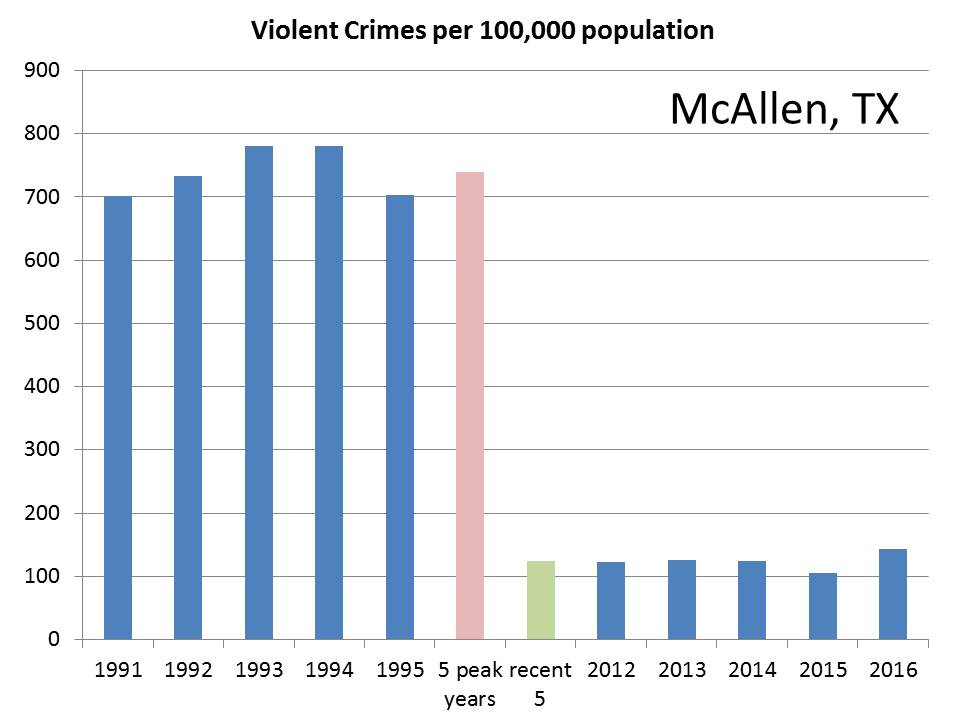
McAllen Violent Crimes. Down by 83.2%
" " Murders. Down by 67.6%
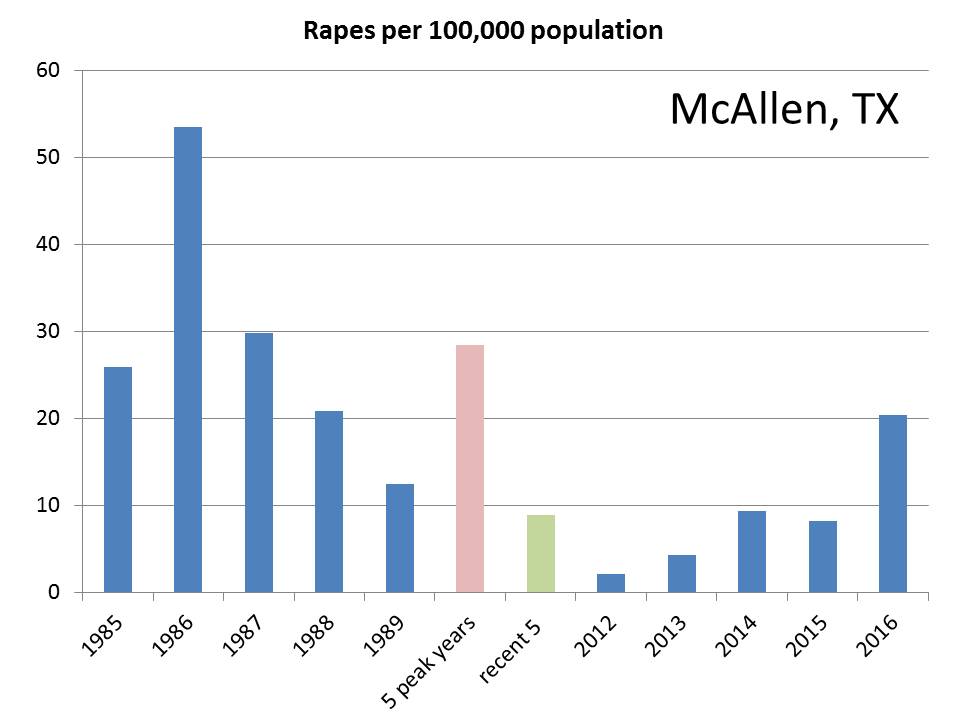
" " Rape. Down by 68.8%
 
Laredo Violent Crimes. Down by 37.7%
" " Murders. Down by 75.7%
" " Rape. Down by 6.1%

While all other city statistics show a 30% drop or more, rapes in Laredo had a negligible drop.

El Paso Violent Crimes. Down by 64.0%
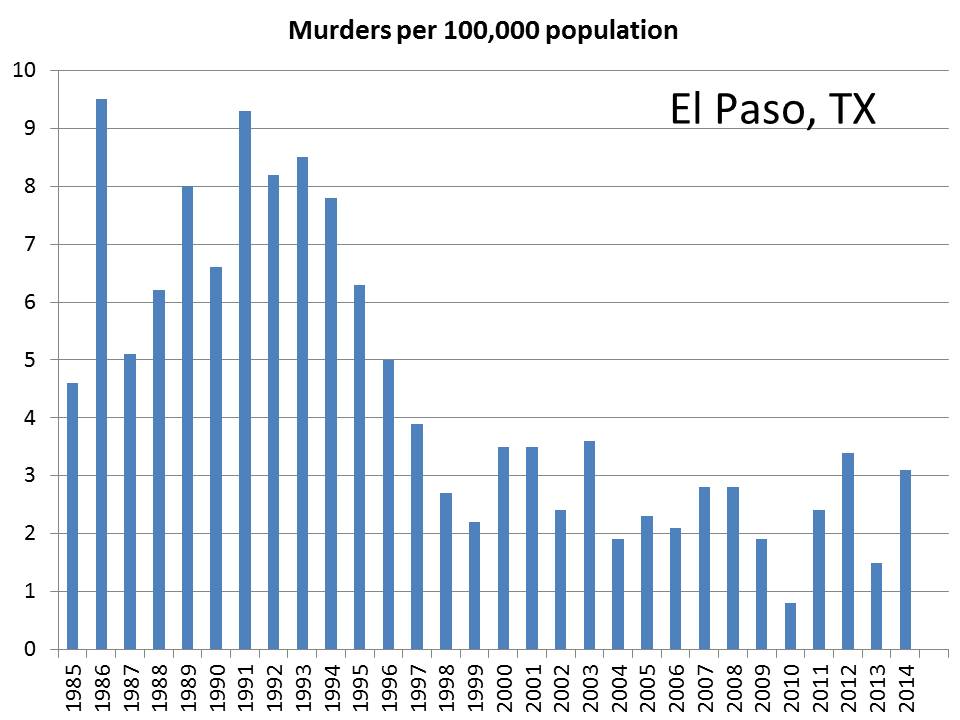
" " Murders. Down by 68.1%
" " Rape. Down by 33.7%


San Diego Violent Crimes. Down by 66.7%
" " Murders. Down by 76.9%
" " Rape. Down by 32.8%

United States. Violent Crimes. Down by 49.3%
" " Murders. Down by 48.6%
" " Rape. Down by 33.7%

Four out of five of the border cities had violent crimes drop at a greater rate than the U.S. as a whole. Five out of five had murder drop at a greater (much greater) rate than the U.S. as a whole. Three out of five of the cities did equal or better in improving their rape statistics. (El Paso tied, San Diego less than one percent behind, and Laredo not doing well.) In total, according to the metrics, the border cities outperformed the U.S. as a whole in 11 out of 15 measures, with one tie.

So, here are the graphs.

Brownsville.


Brownsville, Violent Crimes per 100,000 population. The pink bar represents the average crime rate in the city's peak years of violent crime, which are shown individually in the leftmost bars. The green bar is the average for the five most recent years. FBI UCR statistics are compiled back to 1985.
------------
Brownsville Murder Rates. The legend corresponds to the one described above.
----------
Brownsville, Rate of Rape.
----------

McAllen, Violent Crime Rate.
---------
McAllen, Murder Rate.
--------

McAllen, Rate of Rape. The 2012 statistic of 2.2 per 100,000 seems an anomaly. The 2016 numbers are disturbingly high.
--------
Laredo, Violent Crime Rate.
--------
Laredo, Murder Rate.
---------
Laredo, Rate of Rape. Among the 15 sets of city statistics this one has shown marginal improvement and would even be higher if only the last two years were considered.

--------

El Paso, Violent Crime Rate.

---------
El Paso, Murder Rate.
---------
El Paso, Rate of Rape.

----------
San Diego, Rate of Violent Crimes.
---------

San Diego, Murder Rate.
----------

San Diego, Rate of Rape.

----------------
Martin Hill Ortiz is the author of Never Kill A Friend, Ransom Note Press.


Never Kill A Friend, Ransom Note Press

Never Kill A Friend is available for purchase in hard cover format and as an ebook.
The story follows Shelley Krieg, an African-American detective for the Washington DC Metro PD as she tries to undo a wrong which sent an innocent teenager to prison.

Hard cover: Amazon US
Kindle: Amazon US
Hard cover: Amazon UK
Kindle: Amazon UK
Barnes and Noble 

Martin Hill Ortiz is also the author of A Predator's Game. His epic poem, Two Mistakes, recently won second place in the Margaret Reid/Tom Howard Poetry Competition. He can be contacted at mdhillortiz@gmail.com.

Thursday, May 17, 2018

The Low Crime Rates in U.S. Cities along the Mexican Border.


In a previous post, I looked at the rates of violent crimes in border states. Those states bordering Mexico have had a huge drop in violent crime over the past 20-some years, from the time at which violent crime peaked in the United States in 1992 through 2013, the latter year being the latest data available at the time of my analysis.

The four Mexican border states and the drop in their rates of violent crimes.

California:  -63.3%
Arizona: -40.8%
New Mexico: -35.6%
Texas: -50.1%

These findings are based on the the Uniform Crime Reporting statistics. The UCR stats have been assembled by the FBI going back to the 1930s. In recent years the FBI has put their data online allowing analyses of crime rates according to standardized criteria. The annual data are, for the most part, nine months behind with the year 2016 information appearing at the end of September, 2017. In 2017, the Trump administration decided to provide much less detailed information (70% fewer tables) in comparison to previous years and this will affect future assessments.

Looking at Border Cities.

Alright, states are large and changes in crime in Northern California might not reflect activity closer to the border. So I decided to examine crime rates in another way. The FBI also collects crime statistics for cities. There are five cities on the United States-Mexico border which have a population of over 100,000.

Let's get out of the way two problems with the city statistics. First of all, as of now, the statistics available for these cities is through 2014. Secondly, in 2014, four out of five of these cities switched to the new rape definition and did not report the legacy definition numbers. This leads to an artificial bump in both rape and, to a lesser degree, total violent crime statistics for the final year of this analysis. Using national statistics over a period of four years where both definitions are used, the new definition shows a 38.1% higher incidence of rape.This figure should be reliable represents over 400,000 rapes reported with both definitions.

Violent Crime in Border Cities.

I came to this analysis with an open mind. Would I find an increase in violence? On the one hand, national violence statistics have sharply declined since the nineties. On the other hand, the city of Matamoros, on the Mexican side across the border from Brownsville, gets its name from Mata (Spanish for kill) and Moros (Moors). It did have a death cult causing havoc back in the eighties. So, is violence along the border a spooky fact or spooky myth?

The United States as a Whole.

Violent crime in the United States peaked in 1992. Percent down from peak: -51.8%.

Murders. Peaked: 1986*. Percent down from peak: -54.1%.
Rape. Peaked: 1992. Percent down from peak: -38.3%.

The United States Drop in Violent Crime.

US Decline in Violent Crime Rates
US Decline in Murder Rates
US Decline in the Rate of Rapes, Legacy Definition


A Tour of the Five Border Cities with 100,000 or more in population.


Brownsville is on the Texas-Mexican border near the Gulf of Mexico. In 2014 it had a population of 183,433.
Violent crimes. Peaked: 1988. Percent down from peak: -77.3%.
    Adjusting for legacy definition of rape: -78.5%.
Murders. Peaked: 1986. Percent down from peak: -82.9%.
Rape. Peaked: 2006. Percent down from peak: -30.0%.
    Adjusting for legacy definition: -49.3%


Brownsville Decline in Violent Crime Rate
Brownsville Decline in Murder Rate
Brownsville Decline in the Rate of Rape, Legacy Definition

Conclusion: Brownsville was a dangerous place that has greatly decreased its violence. A concerning recent uptick in rape, but still half of its peak.

McAllen.

Moseying up along the Rio Grande, 60 miles to the northwest, we come to the city of McAllen. In 2014 it had a population of 138,122.

Violent crimes. Peaked: 1994. Percent down from peak: -83.2%.
    Adjusting for legacy rape definition: -84.7%
Murders. Peaked: 1986. Percent down from peak: -56.6%.
Rape. Peaked: 2006. Percent down from peak: -75.7%.
    Adjusting for legacy definition: -82.4%.

McAllen, TX, Decline in Violent Crime Rate
McAllen, TX, Decline in Murder Rate
McAllen, TX, Decline in Rate of Rapes, Legacy Definition


Conclusion: McAllen, also, is a much safer place as is shown by its graphs.

Laredo.

Another three hours up the Rio Grande and you come to the streets of Laredo, once the capital of the Republic of the Rio Grande. In 2014, it had a population of 250,994.

Violent crimes. Peaked: 1989. Percent down from peak: -57.0%.
    Adjusting for legacy rape definition: -58.2%
Murders. Peaked: 1986. Percent down from peak: -68.2%.
Rape. Peaked: 2006. Percent down from peak: -11.9%.
    Adjusting for legacy: -36.2%.

Laredo, TX, Decline in Violent Crime Rate

Laredo, TX, Decline in Murder Rate

Laredo, TX, Decline in Rate of Rapes, Legacy Definition


The results are not quite as dramatic as they are for Brownsville and McAllen, but Laredo has also lowered its crime rate. This city had one high year (1989) in overall violent crime and if the comparisons are made to its established high in the 1990s, the decline is closer to a 40% drop. The rape statistics show a marked increase during the 1990s (prior under-reporting?).

El Paso.

The largest city along the Texas-Mexico border is El Paso. In 2014, it had a population of 680,273.

Violent crimes. Peaked: 1993. Percent down from peak: -64.4%.
    Adjusting for legacy rape definition: -65.6%
Murders. Peaked: 1986. Percent down from peak: -67.4%.
Rape. Peaked: 2006. Percent down from peak: -3.1%.
    Adjusting for legacy: -29.9%

El Paso, TX, Decline in Violent Crime Rate

El Paso, TX, Decline in Murder Rate


El Paso, TX, Decline in the Rate of Rape, Legacy Definition

El Paso has dramatically reduced its violent crime and murder rates. As with Laredo, much of the recent higher (but not highest) rate of rape is due to the revised definition.

San Diego, California has more people than the other border cities combined: in 2014, 1,368,960. They have only reported using the legacy rape definition, so there is no distinction necessary when making comparisons.

Violent crimes. Peaked: 1992. Percent down from peak: -70.3%.
Murders. Peaked: 1991. Percent down from peak: -84.4%.
Rape. Peaked: 1992. Percent down from peak: -35.6%.

San Diego, CA, Decline in Violent Crime Rate
San Diego, CA, Decline in Murder Rate
San Diego, CA, Decline in  Rate of Rapes


San Diego has shown a remarkable decrease in violent crime over the past two-plus decades.


Overall Conclusions.

Each of the border cities have shown a drop in violent crime and murder rate greater than that of the nation as a whole. While the U.S. as a whole saw a greater than 50% drop in the rate of violent crimes and murders, rapes only dropped by -38%. Each of the border cities has a lower rate of rape, with McAllen showing an -82.4% decline, and El Paso showing the least, with a-29.9% decline.

In Perspective.

In Nazi Germany, Jews were labelled as criminals and rapists. Typical is a speech of Goebbels wherein he said he does not deny Jews are humans. Neither did he deny the humanness "of murder[er]s, child rapists, thieves and pimps."

Dylan Roof, who gunned down nine African-Americans in a South Carolina church, declared the day before his attack: "you rape our women and you’re taking over our country. And you have to go."

The local head of the Ku Klux Klan clarified this sentiment: "A better target for him would have been these gang-bangers, running around rapping, raping, and stealing." [Both statements referenced here.]

Birth of a Presidency.

The same week as the comment quoted immediately above, Donald Trump, when making his speech announcing his bid for the presidency, said:

"When Mexico sends its people, they're not sending their best — they're not sending you. They’re not sending you. They're sending people that have lots of problems and they're bringing those problems with us. They're bringing drugs. They're bringing crime. They're rapists. And some, I assume, are good people."


These hateful fantasies have no basis in reality.

A Couple of Statistical Notes.

"Down from peak" is potentially a problematic statistic. It can present artifacts as findings. It works great to define what's going on when you are currently at the peak, or when the peak and trough represent consistent findings. "Down from peak" also does address whether peak violence is occurring. To account for some of its potential bias, the graphs of each year reported in the database are presented.

Legacy Rape. Rape was redefined in 2013 to include more than just forcible rape. In most cases, the legacy definition numbers are included using the older definition which allows for direct comparisons. Overall, the legacy rates compared to the newly defined rates (overall, U.S., per 100,000):

           New  Old (Legacy)
2013  35.9   25.9
2014  37.0   26.6
2015  39.3   28.4
2016  40.4   29.6

Over those four years the revised definition has a 38.1% higher rate than the legacy definition.

The U.S. had its absolute peak in murders in 1980. I chose the year 1986 to be in line with information available from the cities, from 1985 to 2014.

The UCR statistical data tool has been out of service (or just not responsive to my attempts to access it) for about a week and this prevented me from following up on some of the above questions.  Fortunately, I had already downloaded the most relevant data. I hope to write a follow-up piece, soon.

Martin Hill Ortiz is the author of Never Kill A Friend, Ransom Note Press.


Never Kill A Friend, Ransom Note Press

Never Kill A Friend is available for purchase in hard cover format and as an ebook.
The story follows Shelley Krieg, an African-American detective for the Washington DC Metro PD as she tries to undo a wrong which sent an innocent teenager to prison.

Hard cover: Amazon US
Kindle: Amazon US
Hard cover: Amazon UK
Kindle: Amazon UK
Barnes and Noble 

Martin Hill Ortiz is also the author of A Predator's Game. His epic poem, Two Mistakes, recently won second place in the Margaret Reid/Tom Howard Poetry Competition. He can be contacted at mdhillortiz@gmail.com.

Thursday, February 22, 2018

New York Times Fiction List, Male Versus Female Authors.

The Number of Weeks Atop the New York Times Best-selling Fiction Novel List, Males Versus Females.
Above shows the domination of male authors in the period 1979 through 2010 with the red (male author bars) often having more than 40 weeks. In 1993, male authors had 52 weeks. This contrasts to the most recent years, as shown in the graph below.


I have made a number of posts regarding the nature of the books and authors that have made it atop the New York Times Best-Selling Fiction list. These include the age of the authors, the length of stay on top, the length of the books, and the sex of the authors.

I am revisiting this matter due to, in contrast to the early years, women have taken over the top spots in recent years.

The New York Times Bestsellers list first became a national sampling of best-selling books on August 9th, 1942. Men spent more weeks as the author of the number one best-selling fiction book in 51 of the years from 1943 (the first complete year) through 2010 with women dominating in seven years. In ten different years women were shut out with no weeks with the number one novel. More recently, from 2011 onward, women have spent more weeks on top in 5 of 7 years.

A horse race is on. The female dominance began in 2011. However, due to dominance in the year 2010, over the course of the 2010s, males have the overall lead of 209.5 weeks versus 208.5 weeks for women. 

Women have achieved parity so far in the 2010s.


The above expands the right-most portion of the previous graph making it easier to visualize the diminution of male dominance. Since 2011, men have dominated in two years, 2013 and 2017.

Tuesday, October 10, 2017

Hurricane Journal, Part Two.

Saturday, October 1. Day 11. If I didn't have this journal, I wouldn't know it's October. We load up on gasoline. Part of the trick is finding the right station. I see stations with crazy long lines. I find one that takes only 35 minutes.
Now with cash we go to a grocery store and buy some fresh fruit, bread and other basics.
While driving my wife's cell phone snags a signal for a moment. She sends a text message to a query from my family. She has to fight the Spanish auto-correct to get the English words: We are life. We lose the signal.
We go to Domino's pizza for lunch. Internet! It seems too remarkable to be true. I send off some emails and tremulously read about the rest of the world. The rest of the world still exists.
Donald Trump is fighting with the mayor of San Juan. Trump says FEMA is doing a great job and it's only the lying press that says otherwise. Trump says the mayor expects the federal government to do everything, insulting all of the work we've been doing here. Other than the army and lines for ice, I haven't seen the federal government doing anything here. And there is an absolute lack of coordination of information.
Trump is supposed to visit Puerto Rico on Tuesday (Day 14). He has spent years insulting Latinos and his popularity here is zilch.
My sister writes back offering to help us. I don't know what to say. If she sends money to my bank, will I be able to access it? I guess I have checks. Maybe I can find a solar power installer open so I don't have to go through months of no electricity. Maybe they have months-long waiting lists.
We visit Mercedita, the local airport, about the size you'd expect from a town with nearly 200,000. They don't know when flights will resume. San Juan has very limited flights. We are told of a cruise ship that was mobbed by people desperate to escape to Florida, somewhere not destroyed by the storm.
I survived Hurricane Andrew in Florida. Very bad, but there was somewhere to go. Just a little north and you got to Fort Lauderdale, where the hurricane was only a tropical storm and everything was like before.
There is no way off the island.
My son, Carlos, has gone crazy over UNO, playing for hours with the neighbor kid.
The water has disappeared again.
I'm told my neighbor's generator burned out. He's spending the afternoon to repair it. It starts up sounding smooth and survives several hours before firing off a round of explosions and dying.

Sunday, October 2. Day 12. Some water in the morning. We go back to Domino's for lunch, figuring we will get internet again. Nothing, although the cellular makes a connection.
Domino's has a long list of what they don't have. What they do have is thin pizza with a choice of three ingredients. No water, two choices of soda.
I've noticed a lot of this recently. Places are open but they will sell you only what you don't want to buy. Restaurants have two items on their menus.
My neighbor fights with his generator but it only makes it through about three minutes of farting. I learn this is his second generator: he gave up on his first.

Monday, October 3. Day 13. Major goal of the day: refills on medicines. We have three to five days remaining. Walgreen's has "its system down." A group is waiting for the system to return. I'm told they've been waiting three hours. This wouldn't work for everyone because you have to pay in cash: no insurance can be contacted.
I try another pharmacy. This one informs me that without the system of insurance to contact the insurance, the prescription is $277.50, cash. I tell them I can't pay for it. They agree to sell it to me for the price it was the last time with insurance but that I will have to pay the difference if the insurance later declines. With insurance: $5.00.
The generator at the medical school has been out for twenty-four hours before being fixed. All of the scientific specimens are at risk of being lost. The school has also been the place where we've been recharging our electronics which is something we have to skip.
My neighbor now has a small, quiet generator. It purrs softly. He has electricity. Real, uninterrupted, electricity.
To see a movie, we gather around a laptop computer and watch "Die Hard" using its battery.

Tuesday, October 4. Day 14. I see a newspaper. Trump is to visit Puerto Rico today. Fifty-some people slaughtered in Las Vegas.
We come to an intersection with no police guiding traffic. It takes me a moment to realize that it has a working traffic signal.
There are a lot of dead iguanas, killed while crossing the roads. They live in trees and so many of their homes are trashed.
We watch "Die Hard 2." A trail of gasoline on fire moves faster than a jet and can fly into the air to explode it.
Horribly hot night. Humidity, no breeze.

Wednesday, October 5. Day 15. Since I counted the storm as Day One, this means two weeks have passed. That one time we had internet, for all of thirty minutes has spoiled me. I sent out a general email to my family, thinking I would communicate again soon. I'm sure there must be internet somewhere. I am writing this journal with the notion of posting it, but I wonder when that will be.
Cell phone service is extremely spotty. Cars line the roadside in areas where their cell phones work, usually on the peaks of overpasses, their emergency lights blinking.
The car, with air conditioning, is a much more pleasant place to be than in the house.
Trump threw paper towels to hurricane victims. If he had thrown a generator I would have jumped out and caught it.

Thursday, October 6. Day 16. We go back to WalMart and find a butane grill for cheap, thinking we can make some hot meals. No butane. Anywhere. We still haven't found "D" batteries for our portable fan. They have some generators, $800. That's more than I have on me or in the bank. I'm supposed to be paid tomorrow, but will the automatic deposit work?
We get in the wrong line and instead of arriving to pay at a register, I discover that we are lined up for bags of ice. The register at the second line closes on us. The third line works.
We pass a gas station with only four cars waiting. We pull up and wait. Only 10 minutes.
Die Hard 3: Die or Die Trying.

Friday, October 7. Day 17. Worst day ever. I go to work to fix up my office. We have a meeting scheduled for Monday to discuss what we are going to do with the semester. My wife and son arrive at the school, weeping. It seems that when I left for work this morning, I ran over Max, one of our dogs. He's dead.
I had no idea I hit him. No bump, no yelp. I arrange the disposal of his body and clean up some of the blood.
My family want another dog to replace him, preferably immediately. I would rather take time to mourn. They win. We make a visit to Maria Rivera. We call her Maria de los Perros. She rescues strays and makes a home for them. Twenty live in her house and she has another eighty at a fenced in abandoned house in the mountains. She is at her house and we will return tomorrow to go to her dog refuge.

Saturday, October 8. Day 18. We go on a pilgrimage to Maria de los Perros's dog sanctuary. The hurricane has wiped out the last quarter mile of the way there and we have to park and march uphill, carrying water for the dogs. Mudslides cover part of the road. Other parts were washed away leaving a long drop down to the river. Some trees crashed over the fence and several dogs have escaped.
Maria has in mind for us a friendly dog who has been at the compound for four years without finding a home. It is part Shih-Tzu, half-mutt, a Shmutt-zu. Sounds Yiddish. The dog is named Frijolitos, "Beans." She was discovered abandoned when she was tiny enough to be scavenging a meal with her head in a can of beans.
She takes instantly to Carlos, very affectionate. There are several other candidates but we settle on Beans.
We take her home and give her a good scrubbing. She sleeps with Carlos.

Sunday, October 9. Day 19.
I didn't write a post for this day, and now, looking back, two days later, I can't think of a thing that happened.

Monday, October 10. Day 20.
The faculty meet to discuss how to finish the semester. Many options are still open: the students going to Florida or Missouri and the teachers teaching them there. We may continue through December and have final exams in January.
My students, second year, are particularly vulnerable. We have a strict schedule to maintain to prepare the students for the Medical Board exams.
Their classroom lost its roof and is completely trashed. A schedule may include weekend classes.
A main problem is communication. No phone and no internet. I suggest a central bulletin board where we post messages. We discuss PTSD in students and faculty. 
I let out a short scream to summarize my perspective.
My office has internet for a few hours. I read up about the world.
Six p.m., the lights turn on in my neighborhood. Most of the neighbors are outside their houses and break into applause.
Seven p.m. the electricity disappears.
Eight-thirty, it returns. We sleep with air conditioner and fan.

Tuesday, October 11. Day 21.
I meet with my department faculty to plan how we are going to deliver lectures given different possibilities of internet access (we posted videos and notes for the students that were essential to the lectures).
We put together a schedule for the next few weeks using time allotted to my class.
Twelve p.m., internet access, just when my wife and son meet me for lunch. When I return, the electricity goes out for the school and I sit in the dark.

Sunday, October 8, 2017

Hurricane Journal

I am composing this journal as we go along but I don't know when I'll be able to post it. Excuse the rough editing. I've seen internet, anywhere, just once in the last three weeks and then for thirty minutes. When you see this, it will mean I found an internet connection somewhere again and had a chance to post it. I apologize to all those I've not been able to contact.

Monday, September 18. Zero Minus Two. My wife finds passage on the internet, two tickets to Panama for herself and our ten year old son with the hopes of escaping the storm altogether. I don't have the credit available on my card to buy the tickets. I call the credit card company to ask if I can pay using my savings account. No, I'm told. I ask them for an extension on my credit and they transfer me: to fraud. Trying again, this time I'm connected to the right department. After a woman takes all of my information, she says our credit will be extended: in five days. She says she will send a new card by mail. I tell her there won't be mail in five days and cancel the extension.

Tuesday, September 19. Zero Minus One: Most stores are closed, the rest will be closed by noon. We've gathered up supplies and prepare to brave it out in my house. Five five-gallon tanks of fresh water, much more water for washing up. Perishables in the freezer with two bags of ice. Canned goods, nacho chips, other ready-to-eat food. I grab a couple of bags of popped popcorn, figuring that we won't be able to pop any any time soon.
We have an expensive flashlight that is supposed to last for 39 hours before recharging. We have candles. We have extra batteries for the radio and flashlights.
I believe we are ready.
Like most houses in Puerto Rico, ours is built like a bunker: cement walls, flat roof. Luis Ferré, ex-governor, cement manufacturer and philanthropist, preached the importance of build tough housing to survive hurricanes and got rich doing it. However, if we lose our roof, the cement walls will be little comfort.
Final NHC report at 11 p.m.. Maria is 165 mph with possible strengthening and is expected to make landfall over the southeastern part of the island and slice across the whole of the island, hurricane everywhere. It is expected to pass north of Ponce at approximately 11 a.m. Wednesday.
Ponce is a moderate-sized town, about 180,000 people sixty driving miles from San Juan. We are on the south coast.

Wednesday, September 20. Day One. Three in the morning. We are awakened by furious gusts. Soon, the electricity cuts off. My wife notes that she has no cellular service. This surprises me, seems too early. And why the cellular? Four a.m., the winds have picked up to a constant tropical storm force. Six a.m., with "daylight" we can look out the front windows and see the wind whipping the trees. Hurricane force. Eleven a.m., the hurricane is at maximum force, winds still coming from the north. A huge tree topples on to the neighbor's house. The tree in front of our house has lost half of its height from broken limbs. A tree in the vacant lot in back of our house is lashing our roof, making loud banging sounds. I'm afraid the back room might be breached and move everything out.
We have two street-rescue dogs, both Chihuahua-miscellaneous mixes, Max and Chloe. Max is the kind who feigns valor who has used his voice to protect from many mailmen-assassins. He is part kangaroo and loves to jump on to the sofa cushions up to the back of the sofa and then fly through the air. Chloe spins in worried circles, always counterclockwise. Both are terrified and huddle close to us.
At about 1 p.m., the winds have died down, an unnatural drop-off. The eye? Could it have come here? My neighbor shouts to me that he needs my ladder. He climbs to his roof and unstops the drains which are clogged with leaves. I do the same on my house. A flat roof, there is about six inches of standing water. The drain pipes releases water in explosive gushes.
The wind returns, coming from the south. It continues with hurricane force for about three more hours. Then comes tropical force winds with frightening gusts. On this part of the island, I would estimate about four to six inches of rain: nothing terrible.
At six p.m., shortly before dark, we go out to explore. The street connecting to ours is a jungle, so many toppled trees that we have fight our way through to make a path and then go on all fours to crawl beneath toppled trunks. We make our way to the main drag and then head back.
Night falls. We eat bologna sandwiches for dinner.
We discover the nacho cheese dip has jalapeños. The bags of popcorn are jalapeño-flavored. It seems that the last things which I'd grabbed from the store shelves were those with jalapeños.
Remarkably, the water is working and we take drip-showers.
We moved my son's mattress to our bedroom. His room doesn't have any kind of breeze. We barely do, even with the windows open.
Our next door neighbor has an emergency generator which roars like a jet engine and then goes into a coughing fit. It fires off several rounds of M-80s and then dies. He tells us he turned it off because it was too loud to permit sleep.

Thursday, September 21. Day 2. The water stopped. We designate a wastebasket as the chamberpot. We take showers using a bucket and a bowl.
No electricity, no cellular, no phone, no internet. No communication with the rest of the world. One radio station, AM, crackles and pops and talks about the hurricane and gives no useful information.
My wife, Ana, is distressed that maybe she will not be able to get her art to Florida in time for an exhibition.
We go out to explore. Weaving our car between fallen trees we find that, not only are the stop lights not working, most of them are not there. The poles are gone and the wiring is in a tangle across the street.
The fire station looks fine. The first floor business across the street from it has lost its windows, glass and aluminum frames.
Most of the major streets are blocked by fallen poles or trees. The few drivers who have been on the road have worked out the puzzle of which streets are clear enough and we can follow their muddy tracks. An auto parts store has lost its wall. A church is completely trashed.
I see the guard in front of my work, the university. Some buildings are okay, some were damaged.
A huge tree behind a statue commemorating the Taino Indians has fallen. I snap a photo.
At five p.m., we find a restaurant with a generator. The owner is cooking and selling his perishable foods. An hour's wait and we snag the last pizza.
My neighbor has been tinkering with his generator and tonight it sounds like killer bees attacking a nuclear power plant. The bees go silent and die.

Friday, September 22. Day 3. I drive into a gas station that's open. It doesn't have gas and has most of its foods cleaned out. I buy a Diet Coke and a bag of bubblegum. My family has a bubble blowing contest with the next door neighbor kid, who wins.
I clean out all of the broken branches from the trees in front and in back of our house. I have only a handsaw, but it's a well-made one and the effort is good exercise.
I pull a fan out of the back of a scrapped desktop computer. I attach it to a 9-volt battery and hold it front of my face. It works and I have a breeze for about fifteen minutes before the battery dies.
Exploring we find that WalMart is open. A forty-minute line, cash only. An employee personally escorts us as we shop. We buy ice, fruit, some items that are moderately perishable such as bologna. I figure the ice will keep the bologna edible. They have portable fans, D batteries. I buy one but they don't have D batteries. No one does.
A trickle of water today. It shuts off by nightfall.

Saturday, September 23. Day 4. Disorienting. Still no communication with the outside world. No cellular, no phone of any kind. No news. Now there are many more radio stations, but they are maddening in that they say nothing. Various people over the airways describing their plights. They have taken up making pleas to whoever can talk to the outside world, telling them to call families in the States or wherever and provide names and numbers. A man rants that there is no way all of the cellular service and internet could go out unless it was a conspiracy. Donald Trump is using Puerto Rico as a guinea pig to test his future plans for information blackout.
No one has working phones and yet the radio regularly gives out emergency phone numbers.
No cloud cover tonight. Without electricity I was told to expect a remarkable display of stars. I see hundreds. I was promised billions and billions.

Sunday, September 24. Day 5. Have I mentioned our neighbors are great? We drop by on one another bringing snacks and morale. Come evening, groups cluster in the cool evening air and chat. A stone's throw away (–literally, a few year's back we had a problem with someone chucking stones over the wall), there is a massive low-income housing project. It is vacant. I suppose they are all in government shelters. Who wants to pass their time in apartment boxes without electricity? I wonder about those who live on upper floors of buildings, no elevators. I hear a few generators. In my middle class cul-de-sac, we have exactly thirty houses and three have generators.
My neighbor's generator tonight sounds much quieter: like a Harley convention. It sputters and fires bullets. It dies.

Monday, September 25. Day 6. I wonder about FEMA. I guess they are running shelters. I don't see much of them present. I see quarter-mile long lines of people waiting for ice. I do see a lot of locals cutting up trees in the roads along with the Army Reserve. The police have to act as traffic cops at every major intersection. I don't see any car accidents, probably because everyone is looking every direction at once while driving. I also suspect a relative lack of crime. I don't hear police car sirens as often as before the hurricane and few gunshots.
We wash clothes by hand and hang them out to dry.
I work at the Ponce University of Health Sciences. I don't know how we are going to continue the semester. The medical students need to be prepared for the boards, not just given shadow puppet shows as lectures (if we had electricity for light to make the shadows).
Volunteers including me and my son go around cleaning up the damage to the school. The building with the new neuroscience laboratories is trashed: it lost its roof. A half-million dollars to set it up and they moved in Friday before the storm.
My school has a generator, most importantly to preserve valuable biological specimens. They are having trouble finding diesel and are working the generator ten hours on, ten hours off. I go to my lab to recharge devices with rechargeable batteries.
I've given up on finding ice and tossed the perishables from the freezer which now smells bad. 
The water is on with enough strength to take a shower in the shower.
My neighbor's generator sounds like a raid by Pancho Villa.

Tuesday, September 26. Day 7. I drive my family over to visit friends. Don't have to call ahead, no one has a phone. My gas gauge tells me I have 69 miles remaining so I decide today's the day to get gasoline. I tell my wife I'll be back in two hours. After two hours, I can see the station at the end of the line. After four hours, I turn the corner. After five hours I pull in. Cash only. While waiting in my car (air-conditioning on!) I finished the final two hundred pages of a Len Deighton novel and I am eighty pages into another.
I have twenty dollars remaining. I meet someone else who tells me they spent only two hours waiting for gas at a different station.
I find a newspaper, the first time in a week having outside news. (I've listened for hours to radio and there is nothing approaching coherent news.) Hurricane force winds have damaged all of Puerto Rico. Tens of billions of dollars in a place that lives with bankruptcy from not being able to pay tens of billions of bonds. 95% are without electricity or cell phone. Months before electricity will return. Months of these long dark nights. The newspaper includes basketball news but nothing of the baseball standings.
We find a Burger King open. Cash only. They get the order wrong and I protest. When I look at the receipt I realize I don't have money to pay for the correct order. I tell them that and not to change the order to the correct one. They take pity on us and bring the missing hamburger, the one I didn't pay for, to our table. 
While driving home we see a line outside an ATM machine. Those waiting tell us that the machine is going to open in 30 minutes at 6 p.m.. We join them. Others come and the line becomes hundreds long. Six p.m. passes. We wait ten more minutes and then give up, figuring that we'd been suckered by a rumor.
My neighbor's generator sounds like elephants tap-dancing on firecrackers.

Wednesday, September 27. Day 8. My goal today is to find an open bank or ATM. I have two dollars on me and most everywhere demands cash only. I've heard that my bank will open. I pass WalMart and notice their lot is nearly full. It isn't for WalMart, it's for the nearby bank.
I have an idea: I know where my bank has two branches, one across the street from the other. Wouldn't that divide any line in two? I pack water, an umbrella for the sun and a book to read.
The line at the bank isn't horrendous and even better, nearly the entire passage is in the shade. It only took 50 minutes. The bank provided a maximum of $100 and said I could take a hundred more out tomorrow.
Tonight the generator next door sounds like early rocket launches from Cape Canaveral. It blasts out pops before experiencing mission failure.

Thursday, September 28. Day 9. I go back to the bank with high hopes and no umbrella for the sun, after all, yesterday I had to wait less than an hour and mostly in the shade. This branch is closed. The other nearby one has a long line and hours in the sun.
Before going back to the house to get an umbrella to protect me from the sun, I stop at the nearby K-Mart which has just re-opened. I find some size C batteries and also buy a mosquito screen to hang over our front door. Keeping the doors and windows open is a must at night to catch whatever little breeze. The C batteries will operate our boom box, so we won't have to rely only on the pathetic short-wave, AM-FM radio. Cash only. They take all but two dollars. It is 1 p.m. and I believe plenty of time to get some money from the bank.
I get an umbrella and camp out in front of the bank. After two and a half hours, a bank employee announces they will be open for fifteen more minutes. I count 28 people still ahead of me, and I think I might have luck. There are a hundred behind me. Two minutes pass and the bank teller comes out and says there will be five more minutes.
I surrender.
At home, my wife asks me why I blew all of the money at Kmart. I blow up at her yelling it's because I'm stupid. My son, surprised by the outburst, runs to his room and cries.
I try to change a five gallon tank of drinking water and lose hold of the bottle, breaking it and starting a minor flood. Ana's paintings are caught in the flood.
My neighbor has been tinkering with his generator all afternoon. Now it sounds like a Rocket '88: much quieter than any previous incarnations. It purrs along for several hours and then begins popping and dies.
About midnight, I hear his truck turn on. He is sleeping in the air-conditioning of his truck.

Friday, September 30. Day 10. My goal today is to get money from the bank. I have money in the bank. It is mine if I can get it. I am a hunter, a caveman. I must chase down the money for my family. I bring an umbrella for the sun and some water. It is a hot day, no clouds. I get in a line behind about four hundred people, this time starting at 10:30 a.m.
I finish the water in the first hour. There are many elderly people and I wonder how they can survive this wait. We talk to each other. We agree that we have money in the bank and it must be more difficult for the poor. Or maybe, since we can't get our money, we are the poor.
Two hours have passed. In spite of the umbrella, I believe I am getting sunburnt, reflection off of the asphalt. People drop emptied soda cans wherever and they are swarmed by bees. All of the flowers have blown away.
I have the physique of Donald Trump, tall and portly. I also suffer from the heartbreak of tiny hands. The Puerto Rican elderly are thin and tough: beef jerky made human.
Three hours pass. Still about 100 people in front of me. I am dehydrated. I lean against a palm tree while others save my place. Nice folks. I advise one on getting into medical school.
Four hours pass. The line seems to be moving more slowly. I count 58 people ahead of me. Maybe it was a jinx to count: the bank announces they are shutting down early.
I go home. I am exhausted and nearly in heat shock. I climb into bed and sleep.
At five p.m. my wife tells me that she heard of a grocery store that allows you to pay with ATM. We drive there to find it is closed.
On the way home, we pass an ATM with about 30 people in front of it. I think that this is due to another rumor that it is going to open. My wife convinces me to investigate. It is giving out money, the maximum, $500. I'm sure it is going to close before I get to the front of the line. Success. It is 6:30 p.m., dark-dark. We see a line at a Burger King drive-thru and celebrate with warm food. When we return past the ATM we see hundreds waiting in the dark.

Note: I have more, I'll try to edit and post soon. No electricity, no internet, spotty cell phone (October 8).

Part Two.